Published snapshot — May 11, 2026. Company operating figures in this field note describe mato at publication and are not current guidance.
Most people hear "10,000 listeners" and think it's a nice round number. It is. But the number itself isn't the point.
The point is what 10,000 listeners proves about a category of content that wasn't supposed to work.
The economics that kept podcasts small
Traditional interview podcasts are expensive to make. A single episode runs $800 to $2,000 when you factor in host time, guest coordination, recording, editing, and post-production. That's 8 to 12 hours of work per episode.
At those costs, you need roughly 50,000 listeners per show just to break even on ad revenue. Which means the vast majority of interview content that could exist, doesn't. The math kills it before it starts.
Niche topics. Local markets. Industry verticals with small but high-value audiences. All dead on arrival because the production cost floor is too high.
What mato changes
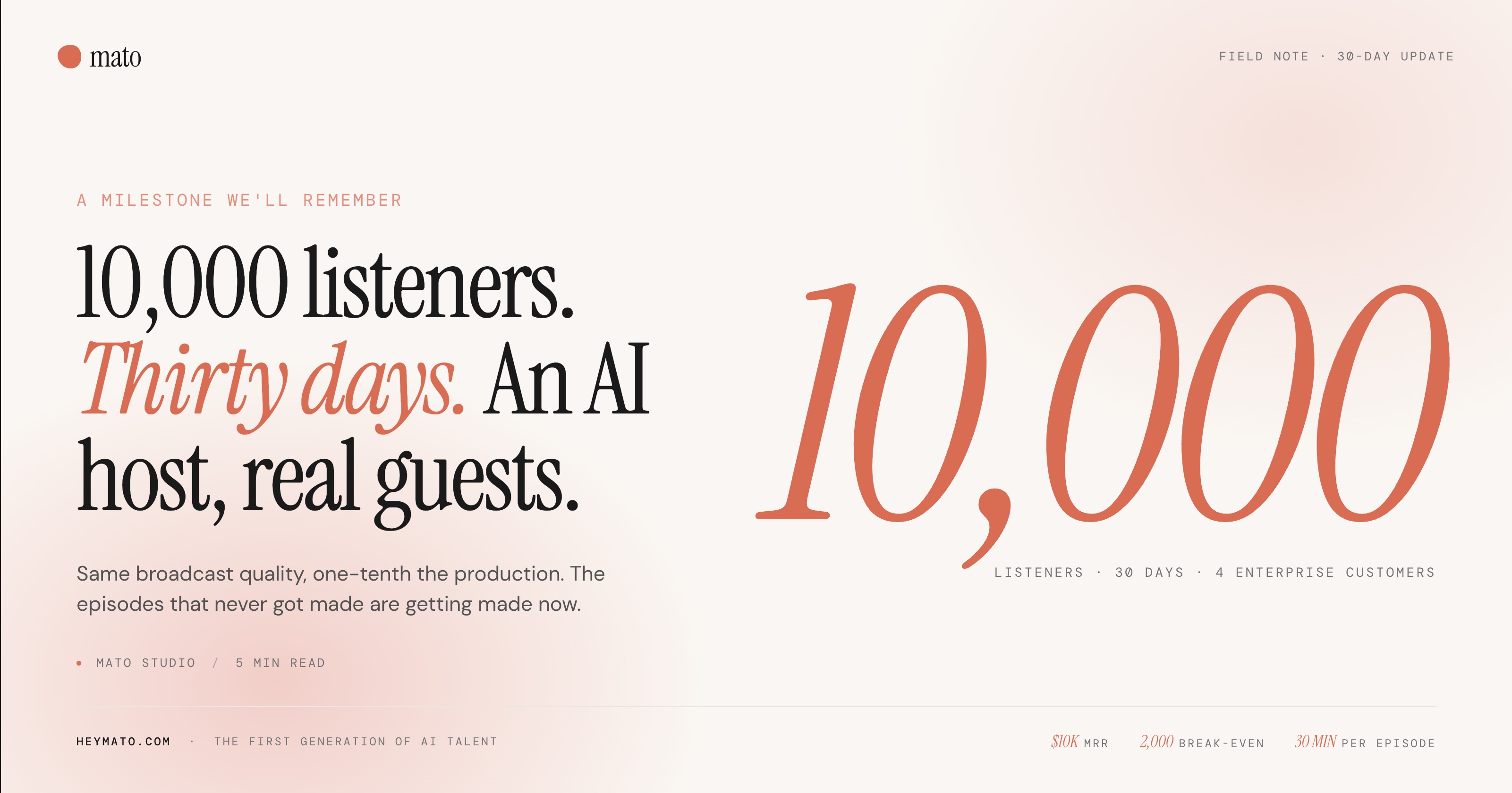
mato drops the break-even audience from 50,000 to 2,000.
We do this by replacing the production burden, not the authenticity. Our AI hosts conduct live, real-time interviews with real human guests. The host asks questions. The guest responds. The host follows up based on what the guest actually said. It's a conversation, not a script read by a synthetic voice.
Many AI podcast tools convert text to speech, generating monologues or dialogues from a script. That's useful for some formats, but it is a different workflow from a live interview. Interviews are where mato starts.
An episode that used to take 8 to 12 hours and cost $800+ now takes 30 minutes and costs $50 to $150. Same broadcast-quality output. Same real human expertise. 95% less time. 90% less cost.
What 10,000 listeners tells us
We crossed 10,000 total listeners across mato-powered shows in our first month of operations. Here's why that matters.
It means people were finding AI-hosted interview podcasts and listening to them. Not bouncing after 30 seconds. Listening. One pilot enterprise customer launched a show on the platform and hit 5,000 listeners in its first week using the same live-interview workflow described here.
At the time of publication, mato had four paying enterprise customers and $10K in monthly recurring revenue, reached from $0 in two months. The enterprise pipeline then included conversations with podcast media houses and advertising networks in the U.S.
These were companies paying enterprise rates because the ROI math worked at that price point.
The market is ready for this
U.S. podcast ad revenue hit $2.9 billion in 2025, up 17.6% year-over-year. 158 million Americans listen to podcasts monthly, an all-time high. 78% of business leaders consume them weekly.
The demand side is massive. The supply side has been bottlenecked by production costs for years. mato removes that bottleneck.
Every niche interest, every local market, every underserved vertical that couldn't justify a $50,000+ annual production budget can now have a podcast that pays for itself with 2,000 listeners. That's a category of content that literally could not exist before.
What's next
At publication, the focus was more customers, more shows, and more evidence that audiences care about the quality of the conversation, not whether the host is human or AI.
10,000 listeners in 30 days is the starting line, not the finish.
If you're a media network, podcast advertising company, or B2B publisher interested in what mato can do for your content strategy, book a mato demo.