
Live Interview
And why does that matter?
This is how a Mato agent talks. Take the other seat: answer a few and feel it follow the thread.
Podcast charts
Published by Ata Sarajedini
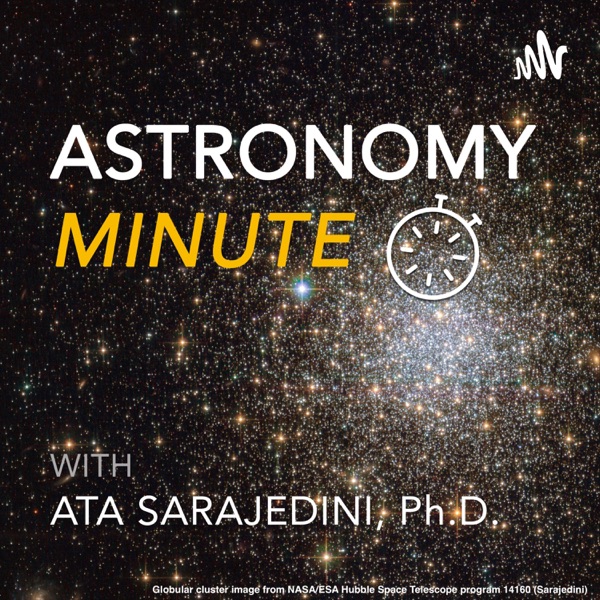
Learn the basics of astronomy in one-to-two minute packets of concise information about specific topics. You are a busy person with a short attention span, and you want to learn about astronomical topics in a short amount of time. Your host Professor Ata is a PhD research astronomer and astrophysicist and a noted authority on stellar and galactic astronomy. I welcome your feedback at ata.sarajedini@gmail.com. See the web site astronomyminute.org for more. The podcast logo is courtesy of Zachary Greathouse and shows a globular cluster photo taken by the author with the Hubble Space Telescope.
On the charts
Every published chart this podcast appears in, in the snapshot behind this page. Each one links to the chart it came off.
From the feed
The latest episodes published to this podcast’s own RSS feed. Titles and descriptions are the publisher’s.
A brief description of what constitutes and astronomical observatory with a few examples in the real world that you have probably heard of.
A brief description of the philosophical concept known as Occam's Razor, which asserts that “the simplest explanation of a particular natural phenomenon is usually the correct one.”
A brief description of why the Webb Telescope is optimized to observe infrared light. Hint: it has to do with the four main science areas that it will be studying: “Other Worlds,” “Star Lifecycle,” “Galaxies Over Time,” and “Early Universe.”
A brief description of the four main science goals of the James Webb Space Telescope - “Other Worlds,” “Star Lifecycle,” “Galaxies Over Time,” and “Early Universe.”
A brief description of the James Webb Space Telescope and how it's different than the Hubble Space Telescope.
A brief description of the Hubble Space Telescope and its scientific capabilities.
A brief description of the two primary reasons why we send telescopes into space to observe and study celestial objects.
A brief historical summary of what we mean when we refer to "Spiral Nebulae."
A brief description of what will happen if the universe stops expanding and collapses back on itself - this is known as the Big Crunch.
A brief description of the basic properties of astronomical objects such as mass, radius, distance, luminosity, and temperature.
A brief description of the Local Group of galaxies which contains the Milky Way, the Andromeda galaxy, and dozens of dwarf galaxies all gravitationally bound to each other.
A brief description of what scientists mean when they say we "know" something.
A brief description of the structure of atoms - how they are mostly empty space - and why the everyday objects you use don't collapse and fall in on themselves.
A brief description of what we mean when we talk about interacting galaxies.
A brief description of nuclear fusion, which is the process by which stars produce light so that they can shine.
A brief description of giant molecular clouds and why they are important for stars.
A brief description of the observational evidence we have supporting our assertion that the Milky Way galaxy is spiral in shape.
A brief description of the 21 centimeter radiation (light) that the Hydrogen atom emits and the mechanism behind this emission.
A brief description of what astronomers mean when they say that "all pulsars are neutron stars but not all neutron stars are pulsars."
A brief description of neutron stars, which are essentially the end state of massive stars some of which become pulsars.
Ranking source
Apple Podcasts rankings via the Mato Topic Intelligence Platform.
Observed September 20, 2026.
Apple and Apple Podcasts are trademarks of Apple Inc., registered in the U.S. and other countries.
Pairs with
Bring this source into Mato to read its transferable patterns, then turn them into an original show for your own audience.