
Live Interview
And why does that matter?
This is how a Mato agent talks. Take the other seat: answer a few and feel it follow the thread.
Podcast charts
Published by Andrew Heaton
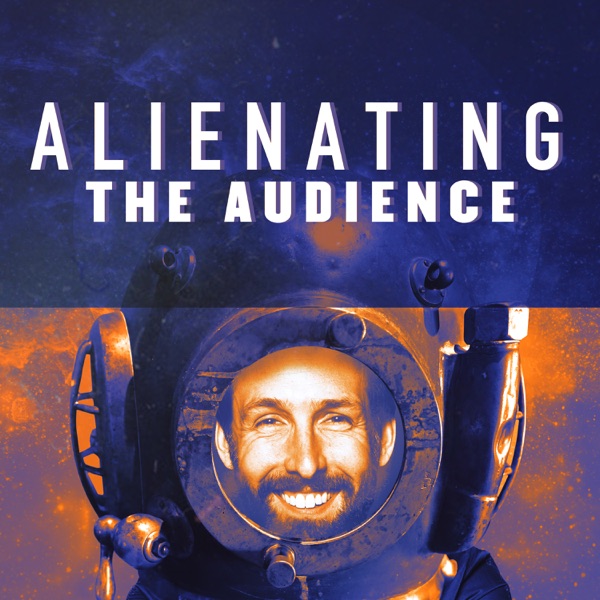
Andrew Heaton and an army of nerds plunge deep, deep into films, books, and TV shows to ask: what's science fiction really about? What is The Twilight Zone really exploring? What are the underlying themes of Star Trek? What is the worldview of Star Wars? Also sometimes Heaton performs comedy on other planets.
On the charts
Every published chart this podcast appears in, in the snapshot behind this page. Each one links to the chart it came off.
From the feed
The latest episodes published to this podcast’s own RSS feed. Titles and descriptions are the publisher’s.
Good Luck, Have Fun, Don't Die is a scrappy sci-fi story about time travel, causality, and whether humanity can be trusted with knowledge of its own future. Henrique Couto returns to unpack the film's big philosophical swings about fate, free will, technological hubris, and the temptation to "fix" history, while also asking the important questions: how much should a time-travel movie explain, when do paradoxes stop mattering, and which character would absolutely destroy the timeline within minutes of getting access to the machine?
"Pluribus is the Borg Collective, but polite and friendly." So says Brian Brushwood, who rejoins the show to discuss Vince Gilligan's latest program, starring Rhea Seehorn.
Science fiction tackles the end of the world again and again, sometimes hopefully and sometimes utterly devoid of it. Josh Jennings joins in this expensive episode to discuss the many, many fates of mankind which come to a close across the worlds of science fiction. Space Tractor: And Other Science Fiction Short Stories https://www.amazon.com/SPACE-TRACTOR-Science-Fiction-Stories-ebook/dp/B0FJPDYMH8/ref=sr_1_1?crid=15MARPN6Y4DM&dib=eyJ2IjoiMSJ9.cFEATJSsQLnfuO9Y2RkgnmYoIvRwTMvIuk0R6Z6ZAp8NsR2mn5D9ml79QeygyBBR4c8Fxvw2jBUe8IGSYGo9x4iQnr3qkIF2HGcmvBRt5p4.HqB3rkgkSY53a9bxfAiHB24WIjWObnR9Rz0eWsJDaCo&dib_tag=se&keywords=josh+jennings+books&qid=1762223518&sprefix=josh+jennings%2Caps%2C125&sr=8-1
In the film "Cabin in the Woods" the grizzly deaths of several archetypical characters are stage-managed by office workers in order to quench the bloodlust of ancient, pagan gods. The film is simultaneously a comedy and a horror, and an excellent romp. Henrique Couto, host of the Weekly Spooky podcast, joins to discuss the film, as well as the appeal of horror, and why that genre in particular excels at meta narratives.
The Prime Directive orders Starfleet officers to refrain from interfering in pre-warprdrive civilizations. It is a doctrine of cultural non-interference... But is it actually a good idea? Scottish Scifi twins Dickie and Stone Lynch return to argue with Heaton about it. Support the show! www.patreon.com/alienating
In "The Last Starfighter" (1984) a young man has his sword-in-the-stone moment playing an arcade game which propels him into heroic intergalactic adventure. Brett Weaver joins to discuss the movie, the Hero's Journey, and to talk about what a sequel or remake would look like. LINKS: Heaton's Otamatone Odyssey https://youtu.be/3BMGPv5RnOQ
In Naomi Alderman's "The Power" women all over the planet suddenly develop the ability to shoot electrical shocks, to the point of lethality. The natural order is entirely inverted, with men easily overpowered by women, and resulting societal tumult. Katherine Mangu-Ward joins to discuss.
Getting thrown back to the same place in time, repeatedly, with little you can do about it has become an awesome sub genre in scifi. From Groundhog Day, to The Endless, we discuss time loops and their appeal in science fiction. Brian Brushwood joins to discuss.
Star Trek's Feringi are intergalactic traders, merchants, entrepreneurs, and feckless shysters. How did they get to be space capitalists when the Federation outgrew the concept of money altogether? Sean Finnerty joins to discuss Feringinar, the Rules of Acquisition, and the economy of the 24th century.
In "Subservience" Megan Fox plays a robot servant who goes off the rails, seduces her owner, and tries to kill his wife. Henrique Couto joins to discuss the ethical implications of cheating on your spouse with a robot, how we ought to treat robots even if they don't really have consciousness, and whether or not we'd buy robot servants in general.
Fresh after seeing "Alien: Romulus," Dickie Lynch and Heaton discuss Ripley Scott's "Alien" franchise: the creepy aesthetics of H. R. Geiger, the deepest fears of the movie, the alien seeding of "Prometheus," and the most recent installment as a best-of.
It's three centuries after the apocalypse, and a small Catholic monastery in the desert is collecting and safeguarding whatever pre-calamite artifacts it can, to preserve knowledge until civilization gets going again. Brian Brushwood joins to discuss this post-apocalyptic "Jesuits in space" novel.
How has A. I. been portrayed through history in science fiction, and what's it going to look like as it keeps getting better? Stone Lynch and J. C. Campbell join to discuss.
Anthony Burgess wrote his dystopian novel "A Clockwork Orange" in 1962, but two different versions appeared on either side of the Atlantic. The American version stops at chapter twenty, whereas the British version has an extra twenty-first chapter, which totally changes the book. Brian Brushwood joins to discuss.
The universe is really, really big. Like huge . Really really really huge. Prompting science fiction to come up with workarounds so everyone isn't stuck on the same boring 'ol planet. Dickie Lynch rejoins to discuss.
Drew Magary's book "The Postmortal" explores a scenario in which a vaccine is made for aging. Whatever age you take it at, you are paused there indefinitely. How does that effect marriage, retirement, and society as a whole? Josh Jennings and Ashland Viscosi return to discuss.
Madeline Miller's "Circe" novelizes the mysterious character from the Odyssey who turns men into swine, but also helps Odysseus get home. The book shows the feckless, narcissistic nature of the Greek pantheon, what is the true nature of self, and the divine patriarchy. Alexandra August and Isabella Reinhardt join to discuss.
George Orwell died way back in 1950, and his estate has never allowed anyone to canonically (or legally) contribute to the immense worldbuilding of "1984"... Until now. Sandra Newman recently wrote "Julia," the official sequel to 1984, which happens conterminously with its events, but from the perspective of Winston's paramour, Julia. Josh Jennings joins to discuss.
Season Finale! In which we talk about how to use sci-fi robots for helpful psychological thought experiments. Support the show! www.patreon.com/alienating ATA Survey: https://docs.google.com/forms/d/e/1FAIpQLSe8FbFXeniKqq4gJNITdQNtbBy4MvUEnZH2m66JteJIJXY-zw/viewform?usp=sf_link
Star Trek Deep Space Nine's Elim Garak is a simple, unassuming character. But also a spymaster. Why is he so beguiling, and what's his character arc? Andrew Young joins to discuss.
Ranking source
Apple Podcasts rankings via the Mato Topic Intelligence Platform.
Observed September 20, 2026.
Apple and Apple Podcasts are trademarks of Apple Inc., registered in the U.S. and other countries.
Pairs with
Bring this source into Mato to read its transferable patterns, then turn them into an original show for your own audience.